The short version
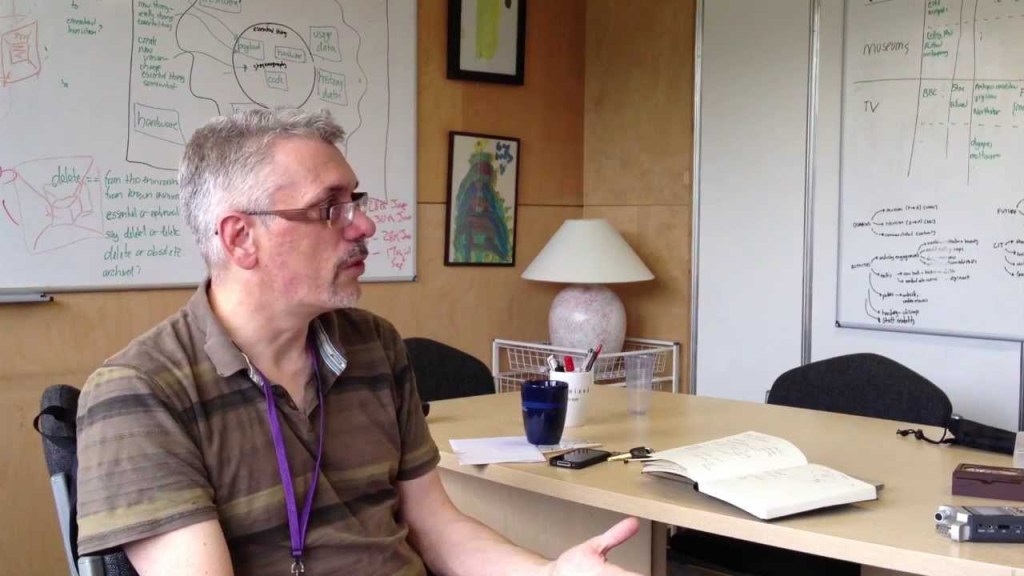
Steve Benford is the Dunford Professor of Computer Science at the University of Nottingham where he co-founded the Mixed Reality Laboratory. He is a UKRI funded Turing AI World Leading Research Fellow exploring “Somabotics: Creatively Embodying Artificial Intelligence”. He also directs the EPSRC-funded Horizon Centre for Doctoral Training.
Steve’s research explores artistic applications of digital technologies through performance-led methods that engage artists in creating, touring and studying unique interactive experiences. In turn, these have inspired fresh perspectives on interaction such as trajectories and uncomfortable interactions. He directs the EPSRC-funded Horizon Centre for Doctoral Training and the University’s newly founded Cobot Maker Space that is exploring human interaction with robots. He was previously an EPSRC Dream Fellow. He is also a keen musician.
The long version
Steve co-founded the Mixed Reality Laboratory in 2000 and has steered the lab’s development since then. He was awarded a UKRI Turing AI World Leading Researcher Fellowship in 2024. He has supervised more than 50 PhDs to completion, including a winner of the BCS Distinguished Dissertation Award, and four who are now Professors, and has been instrumental in training over 150 PhD students via the Horizon CDT. He directed the University’s Smart Products Beacon of Research Excellence, engaging colleagues across the University to forge a new research agenda and establish the Cobot Maker Space.
His contributions to Computer Science span 500+ publications (Scholar h-index 78). He is a leading figure in the field of Human-Computer Interaction (HCI) having published 18 papers in ACM Transactions on CHI (TOCHI), over 50 at ACM CHI (four Best Papers and six Honorable Mentions), being elected to the CHI Academy in 2012, and serving as an Associate Editor of the TOCHI journal. His contributions extend to other areas of Computer Science, for example full technical papers at ACM SIGGRAPH and IEEE Distributed Systems, and to the humanities through publications in performance studies and digital humanities.
Steve has collaborated with artists to deliver groundbreaking artworks and research for three decades. In 2013, He published the method of Performance-led Research in the Wild. Subsequent work established an ethical framework to help others negotiate the challenges raised by sometimes provocative artistic work. His collaboration with Professor Gabriella Giannachi (University of Exeter) helped translate his work to the humanities though our MIT Press book “Performing Mixed Reality”.
He has made significant contributions to embodied interaction beginning with early work on avatars in the 1990s, extending to mobile and tangible interaction in the 2000s, and culminating in his current work with robots. His collaboration with Professor Kristina Höök (Royal Institute of Technology) enriched the method of soma design.
An important aspect of Steve’s work involves delivering conceptual frameworks to support the retrospective analysis and proactive design of interactive experiences. His frameworks for spectator interfaces, trajectories, and uncomfortable interactions have all won best paper awards at CHI, with the latter featuring as a cover article in Communications of the ACM. His work on ambiguity as a resource for interaction design with Professor Bill Gaver has been highly influential and has recently been extended to artificial intelligence.
Steve has been awarded over £100M grant funding from UKRI, EPSRC, AHRC, The EU, industry and charities. He has been the Principal Investigator (PI) on three iterations of the EPSRC funded Horizon Centre for Doctoral Training; Co-Investigator (Co-I) on three iterations of the Horizon Digital Economy Hub; Co-I on the EPSRC FAST Programme Grant; PI on two Platform Grants; and Co-I of the UKRI TAS Hub where I lead the Creative Programme. He previously held an EPSRC Dream Fellowship (2011-2014) to explore creative applications of computing. He was PI of four networks and clusters (three funded by EPSRC and one by ARHC) between 2007 and 2011 that laid the foundations for these initiatives.
Steve has given 30 invited keynotes and distinguished seminars worldwide and published four articles in Communications of the ACM.
Steve’s research has underpinned three REF case studies that evidence how his work has toured worldwide, directly engaged many thousands of people, reached millions more through media coverage, and driven innovation in the creative industries.
Transforming Theatre, Games and Television (REF 2014). Blast Theory collaborations toured to 40 venues in 18 countries, being experienced by 200,000 people and winning multiple awards. Venues included the Royal Festival Hall, Royal Opera House, Edinburgh Festival, Venice Biennale, Sundance Film Festival, Barbican, and Tate Britain. Awards included the Prix Ars Electronica Golden Nica, the world’s premier prize for interactive art. Industry uptake included the EU iPERG project with Sony and Nokia and TSB Participate project with BBC and BT. The Guardian included our work Desert Rain in its “Ten Experimental Theatre Productions that Transformed Theatre”.
Broadcasting thrill for television, advertising and public engagement (REF 2014). Steve’s explorations of thrill with Brendan Walker featured on Blue Peter, The One Show and Discovery Channel. Merlin Entertainment, Summit Entertainment and global advertising agency TBWA engaged us to promote rides, films and a campaign for Nissan.
Innovating Cultural Products for the Creative Industries (REF 2021). Partnership with 20 creative companies innovated further artworks that toured to a 84 venues in 16 countries. Matt Collishaw’s Thresholds was experienced by over 10,000 people. The Horizon CDT spawned two creative companies. Partnership with B3 Media delivered the Talentlab programme, mentoring 30 emerging Black, Asian and Minority Ethnic artists. 1250 decks of the Mixed Reality Game ideation cards were distributed to industry and universities while Culture24 and Europeana engaged 50 museums across Europe with the Visitor Box deck.
 Steve Benford Research